For Authors

Call for Papers

MIG 2026 invites original research contributions in motion, interaction, and games.

Original research for MIG 2026

We invite submissions describing new research results, systems, datasets, methods, and applications related to motion, interaction, and games. Submissions may be long or short papers, depending on contribution scope and maturity.

Paper categories

  • Long papers presenting mature, complete research contributions.
  • Short papers presenting focused results, emerging ideas, or concise technical contributions.
  • All accepted papers should be presented in person at MIG 2026.
Paper submission window 25 July - 7 August 2026
Paper acceptance notification 24 September 2026
Camera-ready deadline 8 October 2026
Deadline timezone All deadlines are 23:59 AoE, Anywhere on Earth.

Topics include, but are not limited to, the following areas:

  • Animation systems and techniques
  • Character motion and control
  • Motion capture, synthesis, and editing
  • Physics-based animation
  • Human-computer interaction for games
  • Interactive simulation and virtual environments
  • Player modeling and game analytics
  • Machine learning for animation and interaction
  • Robotics, embodied agents, and avatars
  • VR, AR, XR, and mixed-reality interaction

Format

We invite submissions of original, high-quality papers in any of the topics of interest mentioned above or any related topic. Submissions can be 4-6 pages for short papers, and up to 10 pages in length for long papers, excluding references. We encourage authors to submit their work as a short paper if the content can fit the 6 page limit (excluding references).

Due to the nature of the conference, we strongly encourage authors to submit supplementary materials (such as videos) with the size up to 200 MB. They may be submitted electronically and will be made available to reviewers. These materials will accompany the final paper in the ACM Digital Library.

All accepted papers, long and short, will appear in the conference proceedings and archived in the ACM Digital Library.

All submissions should be formatted using the SIGGRAPH formatting guidelines (sigconf). A latex template can be found here: https://www.acm.org/publications/proceedings-template
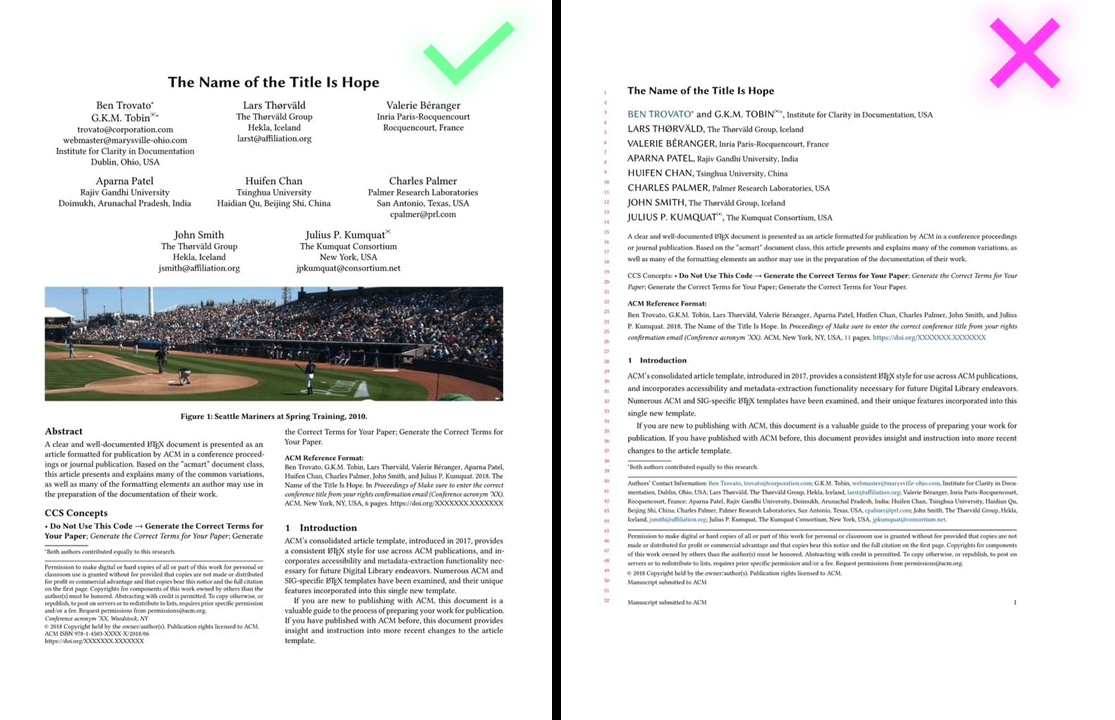
example of correct and incorrect paper formats

For the review version, please use the command:

\documentclass[sigconf, screen, review, anonymous]{acmart}

All submissions will be double-blind peer-reviewed by our international program committee for technical quality, novelty, significance, and clarity. Double-blind means that paper submissions must be anonymous and include the unique paper ID that will be assigned upon creating a submission using the online system.

Papers should not have previously appeared in, or be currently submitted to, any other conference or journal. For each accepted contribution, at least one of the authors must register for the conference. There is no rebuttal process.

All submissions will be considered for the Best Paper, Best Student Paper, and Best Presentation awards, which will be conferred during the conference. Authors of selected best papers will be referred (under validation) to submit extended and significantly revised versions for a Special Issue of Computers & Graphics journal.

ORCID

Please ensure that you and your co-authors obtain an ORCID ID, so you can complete the publishing process for your accepted paper.  ACM has been involved in ORCID from the start and we have recently made a commitment to collect ORCID IDs from all of our published authors. We are committed to improve author discoverability, ensure proper attribution and contribute to ongoing community efforts around name normalization; your ORCID ID will help in these efforts.”

Review criteria

Papers will be reviewed for originality, technical quality, clarity, significance, reproducibility where applicable, and relevance to motion, interaction, and games.

Add final policy text for anonymity, conflicts of interest, ethics, accessibility, and publication requirements here.

ACM Publication Policies

By submitting your work to an ACM Publication, you are hereby acknowledging that you and your co-authors are subject to all ACM Publications Policies, including ACM's new Publications Policy on Research Involving Human Participants and Subjects. Alleged violations of this policy or any ACM Publications Policy will be investigated by ACM and may result in a full retraction of your paper, in addition to other potential penalties, as per ACM Publications Policy.

Please ensure that you and your co-authors obtain an ORCID ID, so you can complete the publishing process for your accepted paper. ACM has been involved in ORCID from the start and we have recently made a commitment to collect ORCID IDs from all of our published authors. We are committed to improve author discoverability, ensure proper attribution and contribute to ongoing community efforts around name normalization; your ORCID ID will help in these efforts.

ACMs new open access publishing model for 2026 ACM Conferences

Starting January 1, 2026, ACM will fully transition to Open Access. All ACM publications, including those from ACM-sponsored conferences, will be 100% Open Access. Authors will have two primary options for publishing Open Access articles with ACM: the ACM Open institutional model or by paying Article Processing Charges (APCs). With over 2,600 institutions already part of ACM Open, the majority of ACM-sponsored conference papers will not require APCs from authors or conferences (currently, around 76%).

To be included in ACM Open, the corresponding author must be affiliated with a participating institution. For APC-eligible articles (research, short paper, and survey) where none of the authors are currently from participating institutions, an APC will be required.

Authors from institutions not participating in ACM Open will need to pay an APC to publish their papers, unless they qualify for a financial waiver. To find out whether an APC applies to your article, please consult the list of participating institutions in ACM Open. Keep in mind that waivers are rare and are granted based on specific criteria set by ACM.

Understanding that this change could present financial challenges, ACM has approved a temporary subsidy for 2026 to ease the transition and allow more time for institutions to join ACM Open. The subsidy will offer:

Authors No ACM or SIG members At least 1 ACM or SIG member
ACM and SIG Sponsored Conf. Article $350 $250

This represents a 65% discount off the regular APC list prices, funded directly by ACM. Authors are encouraged to help advocate for their institutions to join ACM Open during this transition period. This temporary subsidized pricing will apply to all conferences scheduled for 2026.